



How to Avoid Getting Banned by Boosting Lolboost.gg: Essential Safety Tips for League of Legends Players
League of Legends boosting through services like lolboost.gg can accelerate rank progression, but it carries inherent risks that players must understand before proceeding. The most effective way to avoid getting banned when using lolboost.gg is to select boosters who use VPNs matching the account's region, maintain normal play patterns, and limit communication during boosting sessions. Account security measures have become increasingly sophisticated, making it essential to take specific precautions.
Players who choose to boost their accounts need comprehensive knowledge of detection mechanisms and protective strategies. The difference between a successful boost and a banned account often comes down to technical details and behavioral patterns that raise red flags in Riot's systems.
This guide examines the specific risks associated with boosting, outlines practical safety measures, and explores the broader implications of rank enhancement services. Understanding these factors allows players to make informed decisions about their accounts and competitive standing.
Understanding Ban Risks When Boosting on lolboost.gg

Riot Games employs sophisticated detection systems to identify account sharing and unusual gameplay patterns, while players face permanent account suspension and loss of all purchased content if caught using any lol boosting service.
How Riot Games Detects Boosting Activities
Riot Games tracks IP addresses, hardware IDs, and geographical login patterns to identify when multiple users access the same account. A sudden change from one city to another within hours raises immediate red flags in their system.
The company analyzes gameplay metrics including average clicks per minute, champion pool changes, and performance spikes. When an account suddenly jumps from silver to platinum with different champions and playstyles, detection algorithms flag this as potential elo boosting lol activity.
Machine learning models compare historical player behavior against current sessions. These systems examine ward placement patterns, item build orders, skill shot accuracy, and decision-making tendencies. Any significant deviation from established patterns triggers review processes.
Types of Suspicious Behavior Monitored
Login location changes represent the most obvious red flag for any league of legends boost service. When accounts access servers from different countries or states without reasonable travel time, automated systems generate alerts.
Win streak anomalies combined with champion mastery discrepancies indicate boosting. An account that previously played 200 games on support champions suddenly winning 15 consecutive matches on high-skill assassins appears suspicious.
Communication pattern shifts also trigger detection. Players who suddenly stop chatting, change their typing speed, or use different languages than their match history shows face scrutiny. Performance consistency matters too—maintaining challenger-level mechanics throughout every game session proves difficult for legitimate players but common in lol elo boost scenarios.
Consequences of Getting Banned
Permanent account suspension results in immediate loss of access to all champions, skins, and purchased content. Players cannot recover banned accounts regardless of money spent or time invested. Riot does not offer appeals for confirmed boosting violations.
Hardware bans prevent players from creating new accounts on the same computer. These bans target specific device identifiers, forcing banned users to purchase new hardware to access League of Legends again.
Ranked rewards from current and previous seasons disappear upon ban confirmation. Players lose victorious skins, borders, and rank emblems. Associated email addresses may face restrictions preventing new account creation for lol elo boosting purposes.
Key Precautions to Avoid Getting Banned
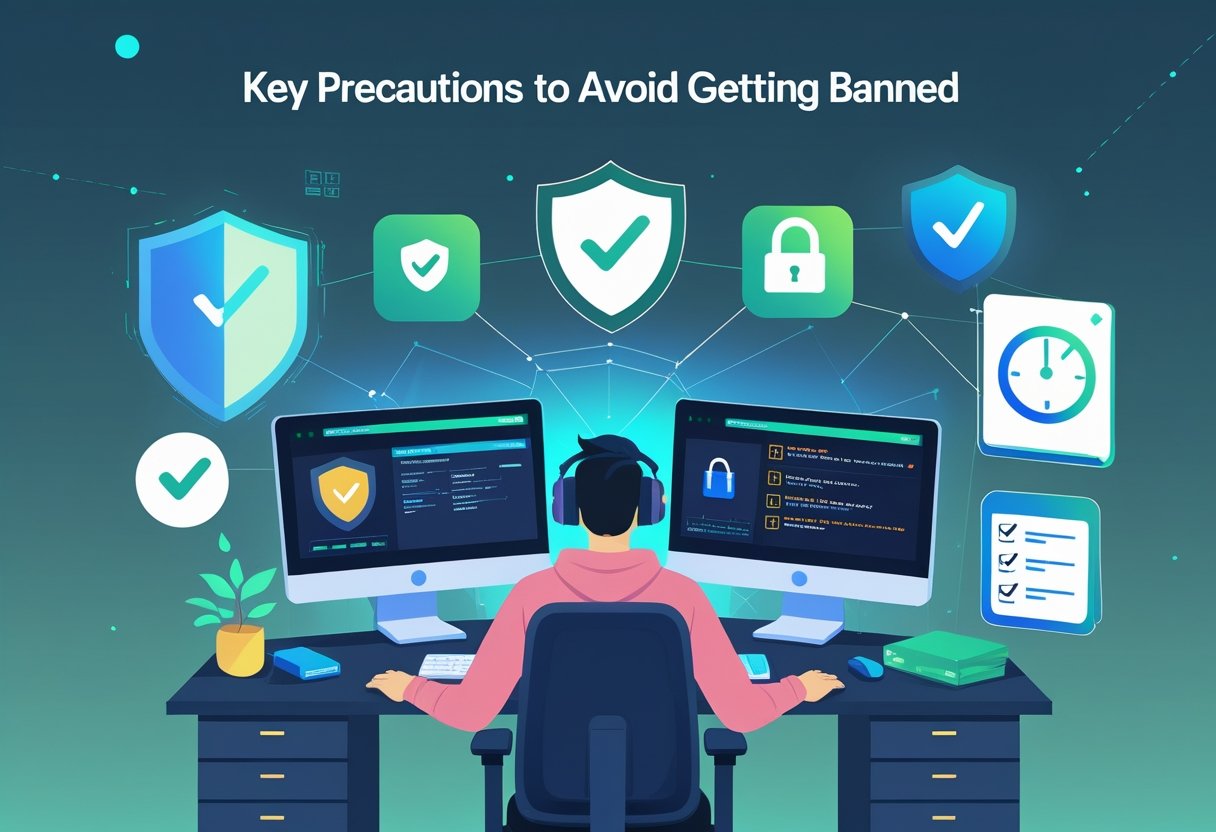
Players who use boosting services need to implement specific safety measures to protect their accounts from detection. The right service selection, proper account handling, and understanding platform policies create layers of protection against bans.
Selecting Secure LoL Boosting Services
Choosing a reputable lol boosting service significantly reduces ban risks. Services like lolboost.gg implement security features that distinguish them from less reliable providers.
Key security indicators include:
- VPN protection that masks location changes during boost sessions
- Offline mode options to hide online status from friends
- Communication channels for coordinating play schedules with boosters
- Account verification processes that prevent data breaches
Professional boosters at established services use clean accounts with no history of violations. They avoid scripting, botting, or other detectable third-party software. The service should offer customizable boost speeds rather than rushing through ranks, which triggers automated detection systems.
Players should verify the service provides insurance or replacement guarantees if bans occur. This demonstrates confidence in their methods and accountability for results.
Important Account Safety Practices
Players must take direct action to minimize detection risks during ranked boost sessions. Removing recent players from the friends list prevents them from noticing skill discrepancies or unusual play patterns.
Coordinating schedules with boosters ensures no conflicts occur when both parties attempt to access the account. Players should provide accurate MMR information and champion pool details so boosters maintain realistic performance patterns.
Critical safety steps:
- Change passwords before and after boosting sessions
- Enable two-factor authentication
- Avoid logging in during active boost periods
- Provide specific instructions about champion preferences
- Request match history reviews before finalizing
Players should never share account information through unsecured channels. League of legends boost sessions require patience—rushing or pressuring boosters to complete orders faster increases reckless play that draws attention.
Understanding Boosting Policies on lolboost.gg
The platform operates within specific guidelines to maintain service quality and account security. Lolboost.gg assigns boosters based on skill requirements and regional server expertise.
The service structures ranked boost orders to mirror natural progression patterns. Boosters maintain consistent play schedules rather than marathon sessions that flag automated systems. They use champions the account owner has played previously whenever possible.
Lolboost.gg implements mandatory waiting periods between games during intensive boost sessions. This mimics authentic player behavior and reduces detection algorithms' effectiveness. The platform monitors booster performance to ensure compliance with safety protocols and removes providers who generate ban reports.
Safe Methods of Boosting: Strategies and Best Practices
Choosing the right boosting method and following consistent practices significantly reduces detection risks. The approach taken during duo boosting lol sessions, placement matches boost scenarios, and daily play patterns all impact account security.
Duo Queue Boosting Versus Solo Queue Boosting
Duo queue boost services allow the account owner to play alongside the booster, which appears as normal gameplay to Riot's detection systems. This method generates authentic game data since two players queue together legitimately.
Solo queue boost involves giving account credentials to the booster who plays alone. This creates more risk because login patterns, IP addresses, and gameplay styles change dramatically. Riot's systems flag sudden shifts in champion pools, mechanical skill, and decision-making patterns.
Duo boosting lol provides these advantages:
- Account owner maintains partial control
- No credential sharing required
- Normal login patterns continue
- Gradual skill improvement appears more natural
The tradeoff is that duo queue boost takes longer and costs more since the booster must compensate for the account owner's skill level during matches.
Placement Matches Boost Tips
Placement matches boost services carry heightened risk because Riot monitors these games more closely for smurfing and boosting. New season placements determine starting ranks, making them attractive targets for detection systems.
Players should avoid winning all placement matches at unrealistic win rates. A 7-3 or 8-2 record appears more legitimate than 10-0. The booster should play champions that exist in the account's match history rather than introducing entirely new picks.
Key considerations during placement matches:
- Maintain champion pool consistency
- Avoid perfect KDA ratios every game
- Space matches across multiple days
- Use roles previously played on the account
Maintaining Consistent Play Schedules
Sudden changes in play schedules alert automated systems. An account that normally plays evenings but suddenly shows activity at 3 AM in a different timezone raises flags.
Boosters should match the account owner's typical gaming hours as closely as possible. If the account plays 2-3 games per day on weekday evenings, the booster should follow similar patterns. Marathon sessions of 15+ games in one day deviate from established behavior.
lp boost sessions work best when distributed across the same days and times the account naturally plays. Players should communicate their regular schedule to the boosting service. A gradual climb over two weeks appears more legitimate than 20 consecutive wins in 48 hours.
Monitoring Your Account Health During and After a Boost
Active account monitoring helps detect potential issues early and prevents ban risks. Players should track login activity, game performance metrics, and any system notifications throughout the boosting period and afterward.
Checking for Warning Signs or Restrictions
Players need to regularly check their account for unusual system messages or behavioral warnings. Riot Games sends notifications when detecting suspicious activity, including unusual login locations or gameplay patterns that don't match historical data.
The client's notification center displays warnings about potential account security issues. Players should review their match history daily during an mmr boost to ensure games appear normal and consistent with the service agreement.
Email notifications from Riot require immediate attention. These messages often contain information about login attempts, password changes, or detected anomalies in gameplay patterns that could trigger automated detection systems.
Key warning signs include:
- Login attempt notifications from unexpected locations
- Account restriction messages in the client
- Temporary chat restrictions or honor level drops
- Unusual friend requests or honor notifications
- Changes to account settings without authorization
Securing Your Login Credentials
Password changes before and after the boost reduce unauthorized access risks. Players should use unique, complex passwords that differ from other online accounts to maintain security throughout the mmr increase process.
Two-factor authentication should remain disabled only during active boosting sessions. Enabling 2FA immediately after service completion prevents unauthorized access while the booster no longer needs account entry.
Players must verify their email address remains unchanged and accessible. Boosters should never modify email settings, and any unauthorized changes indicate potential account compromise requiring immediate action.
Login history tracking through Riot's account management portal shows all access attempts. Players should document their normal login patterns before boosting starts to identify any discrepancies during or after service completion.
Post-Boost Behavior Adjustments
Playing at the new rank requires gradual adaptation to maintain believable performance patterns. Jumping directly into ranked games after significant lp gain creates statistical anomalies that automated systems flag as suspicious.
Normal games or ARAM matches help players adjust to their new MMR without risking detection. These game modes allow skill development at the boosted rank while establishing natural gameplay patterns in Riot's systems.
Champion pool consistency matters after rank changes. Players should gradually expand their champion roster rather than immediately playing champions never touched before the boost, which creates obvious pattern breaks in account history.
Performance metrics should stabilize over 10-15 games following boost completion. KDA ratios, CS numbers, and vision scores need time to normalize at the new rank without dramatic fluctuations that suggest account sharing.
Long-Term Reputation Management and Rank Climbing
Maintaining a boosted account requires strategic gameplay patterns and careful attention to match history consistency. Players need to balance quick advancement with sustainable practices that don't trigger automated detection systems.
Consistent Play for Natural Rank Increase
Players should space out ranked games over several days rather than playing dozens of matches in a single session. This mimics natural player behavior and prevents sudden win rate spikes that appear suspicious.
The account holder needs to maintain a win rate between 50-60% after the boost completes. A drastically higher win rate signals artificial assistance, while too low suggests the player cannot maintain their new rank legitimately.
Champion pool consistency matters significantly. Players should stick to 3-5 champions they genuinely understand at their new rank level. Switching champions frequently or performing poorly on previously successful picks raises red flags in behavior analysis systems.
Match performance metrics should align with the rank tier. This includes CS per minute, vision score, damage output, and KDA ratios appropriate for the division. Players must practice these fundamentals to sustain their position.
How to Maintain Boosted Ranks Safely
Gradual skill improvement prevents immediate rank decay. Players should spend time in normal games or practice modes learning matchups and mechanics common at their boosted rank before jumping into ranked queues.
The first 10-20 games after receiving a boosted account are critical. Playing during peak hours (6 PM - 11 PM) helps blend in with regular player activity patterns. Off-hour gaming sessions can appear as booster activity to detection algorithms.
Duo queue with similarly ranked players adds legitimacy to the account. Solo queue performance that dramatically differs from duo queue results can indicate rank boosting services were used.
Players should avoid rank up fast strategies immediately after boosting ends. Aggressive climbing attempts often lead to losing streaks that expose skill gaps and prompt manual reviews of the account history.
Legal and Ethical Considerations of Boosting
League of Legends boosting operates in a gray area that players need to understand before purchasing services. Riot Games explicitly prohibits account sharing and boosting activities, which can lead to permanent account suspension.
Understanding League of Legends Terms of Service
Riot Games' Terms of Service strictly forbid account sharing, which forms the basis of most lol elo boosting services. The company considers boosting a violation because it involves giving account credentials to another player who then logs in to raise the account's rank.
The Terms of Service state that accounts are personal and non-transferable. When players use a league of legends boost service, they breach this agreement regardless of whether money changes hands.
Riot has the right to suspend or permanently ban accounts that violate these terms. The company uses various detection methods to identify boosted accounts, including unusual login locations, sudden changes in gameplay patterns, and champion pool shifts.
Players should know that no boosting service can guarantee complete safety from detection. Even services that claim to use VPNs or other security measures cannot eliminate the risk entirely.
Potential Impact on Your Account's Standing
Account penalties for boosting range from temporary suspensions to permanent bans. Riot typically issues warnings for first-time offenders, but repeat violations result in harsher consequences.
A banned account loses all purchased content, including skins, champions, and event passes. Players forfeit any money spent on the account over its lifetime, which can amount to hundreds or thousands of dollars.
Beyond immediate penalties, boosted accounts may face ongoing scrutiny from Riot's detection systems. The company maintains records of previous violations, making future infractions more likely to result in permanent bans.
Players also risk losing their ranked rewards if caught boosting before the season ends. Riot can revoke seasonal rewards retroactively if they determine an account received unauthorized assistance.